Planning when to visit Southeast Asia requires understanding that the region’s weather is not uniform. Southeast Asia weather patterns vary significantly between countries and even between regions within the same country, meaning that while one area is soaked by monsoon rains, another is enjoying its finest sunshine. This complete month by month guide covers the best time to visit Southeast Asia for Thailand, Vietnam, Malaysia, and Bali.
Understanding Southeast Asia Weather
Southeast Asia lies within the tropical zone, with two primary seasons in most areas: a wet season (monsoon) and a dry season. The timing and intensity of these seasons varies significantly:
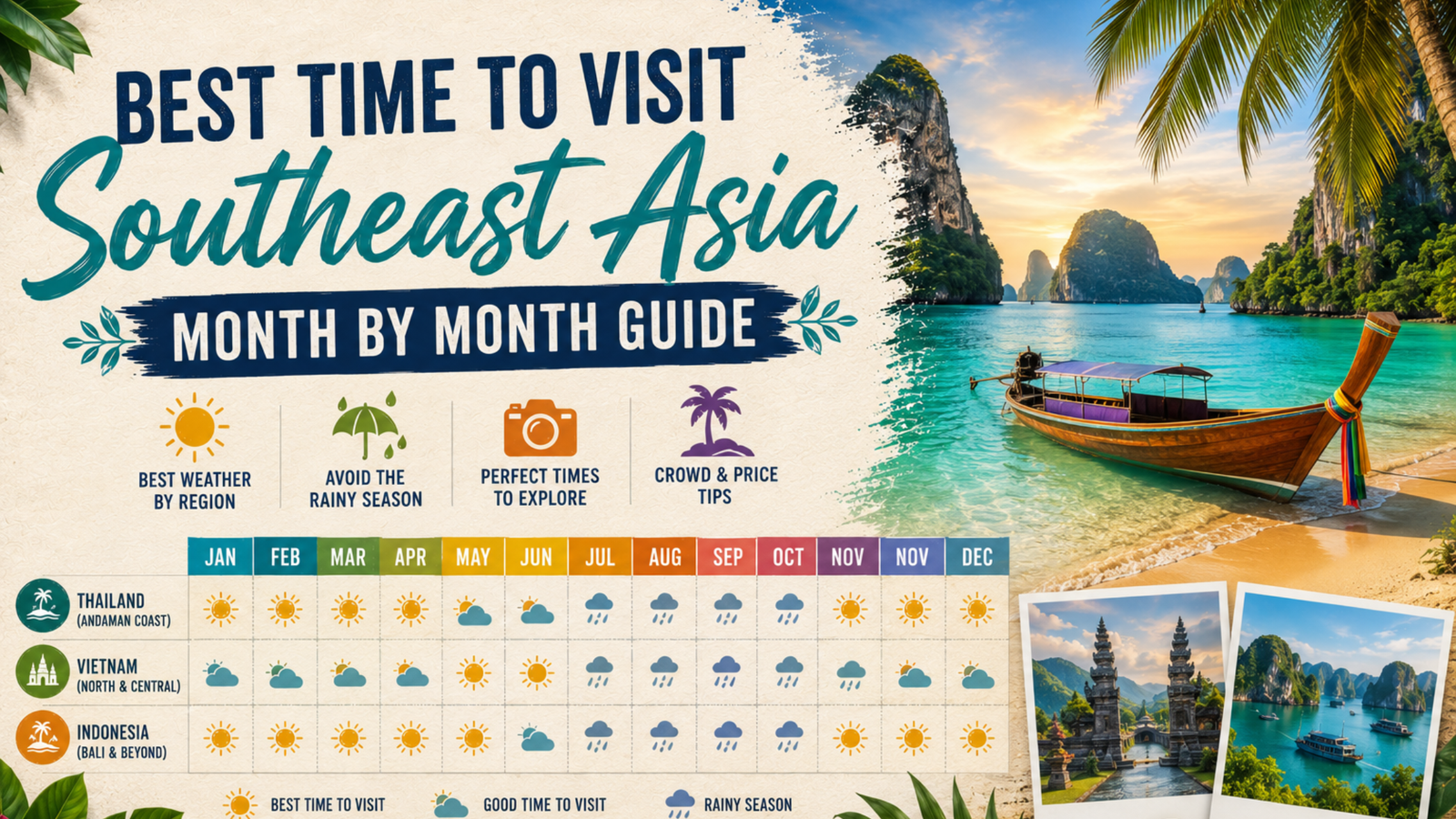
The Andaman coast of Thailand, the west coast of Malaysia, and Bali follow a similar pattern with the wet season from May to October.
The Gulf coast of Thailand and the east coast of Malaysia have an opposite wet season from October to February, when the Andaman side is typically dry.
Vietnam’s weather is more complex: the north has a cool, dry winter and hot, wet summer; the south is essentially dry from November to April and wet May to October; the central coast experiences the heaviest rain from September to November.
Understanding these patterns is the most important single factor in planning when to go to Southeast Asia.
Month by Month Guide: Best Time to Visit Southeast Asia
January
January is excellent for Bali, Thailand’s Andaman coast (Phuket, Krabi), and Malaysia’s west coast (Penang, Langkawi). Clear skies, lower humidity, and some of the best beach conditions of the year. Vietnam’s south (Ho Chi Minh City) is in its dry season. Hanoi is cool and occasionally foggy.
Best destinations in January: Bali, Phuket, Krabi, Langkawi, Penang, Ho Chi Minh City
February
February mirrors January conditions across most of the region. Bali and Thailand’s Andaman coast continue in their finest weather. The Thaipusam festival in Malaysia is typically in February, offering a unique cultural experience at Batu Caves. Vietnam’s Tet (Lunar New Year) celebrations typically fall in January or February, creating vibrant street celebrations but also significant domestic travel congestion.
Best destinations in February: Same as January, with the addition of cultural festival experiences in Malaysia and Vietnam
March
March marks the final month of excellent dry season conditions across most of the best time to visit Southeast Asia window. Thailand’s beaches remain beautiful. Bali is still excellent. The heat begins to build in Vietnam’s north toward April.
Best destinations in March: Bali, Thailand Andaman coast, Penang, Langkawi, Ho Chi Minh City
April
April is Songkran month in Thailand, when the Thai New Year water festival transforms cities into joyful water fights throughout mid-April. If you want to experience Songkran, it is one of the most memorable things to do in Thailand. If you want to avoid it, schedule temples and cultural visits outside the Songkran window.
April is also the final month of Bali’s dry season shoulder period before the busy May to October dry season proper begins. Southeast Asia weather across most areas remains dry.
Best destinations in April: Thailand (Songkran experience), Bali, Langkawi
May
May marks the beginning of the wet season for Thailand’s Andaman coast and Bali, but this does not mean constant rain. Afternoon showers are typical, with sunny mornings generally remaining available. Prices drop and crowds thin significantly.
Vietnam’s north begins its wettest period (May to September). Vietnam’s south remains in relatively good shape through May.
Best destinations in May: KL, Penang, Vietnam’s south and central coast (before the central coast rainy season begins), Bali (acceptable with afternoon showers)
June
June is the start of the best season for Gulf of Thailand islands (Koh Samui, Koh Tao, Koh Phangan) and Vietnam’s east coast beaches (Da Nang, Hoi An). The Andaman coast has more rain but is still perfectly manageable.
Best months SEA for Gulf of Thailand: June to October
Best destinations in June: Koh Samui, Koh Tao, Da Nang, Hoi An, Hanoi (manageable)
July and August
July and August are peak tourist months throughout Southeast Asia due to European and Australian school holidays. Thailand’s Gulf islands, Bali, and KL are busiest. Prices rise and accommodation books out faster. The Andaman coast has its wettest months.
Bali is in high season and spectacular despite brief showers. Vietnam’s central coast is in its best beach window.
Best destinations in July/August: Koh Samui, Koh Tao, Bali, Da Nang, Hoi An
September
September is one of the most recommended best months SEA for experienced travelers. Bali remains in its dry season with slightly smaller crowds than July/August. The Gulf coast of Thailand continues excellent. Central Vietnam starts getting wetter toward October.
Best destinations in September: Bali, Koh Samui, Koh Tao
October
October begins the transition to the northeast monsoon across the Gulf of Thailand, Koh Samui, and Vietnam’s central coast, which sees its heaviest rainfall from October to November. However, the Andaman coast (Phuket, Krabi) begins to clear and improve as October progresses.
Best destinations in October: Phuket (improving), Langkawi, Vietnam’s south
November
November sees the Andaman coast come back into full dry season condition, offering some of its best weather of the year. Vietnam’s central coast (Hoi An, Da Nang) experiences its heaviest rains. Ha Long Bay is accessible but mist can limit views.
Best destinations in November: Phuket, Krabi, Langkawi, Ho Chi Minh City
December
December is peak tourist season across most of Southeast Asia as European and Australian summer holidays coincide with the dry season. Prices spike for Christmas and New Year. Bali, Phuket, Krabi, and Langkawi are all at their finest weather-wise but busiest.
Best destinations in December: All-around excellent across Thailand Andaman, Bali, Langkawi, with the trade-off of peak crowds and prices
Best Time to Visit Southeast Asia: Country Summary
| Country/Area | Best Months | Avoid |
|---|---|---|
| Thailand Andaman (Phuket, Krabi) | Nov to April | June to October |
| Thailand Gulf (Koh Samui, Koh Tao) | June to October | Oct to Jan |
| Bali | April to October | November to March |
| Malaysia west coast | Nov to April (drier) | Year-round accessible |
| Malaysia east coast | March to October | Nov to Feb |
| Vietnam south (HCMC) | Nov to April | May to October |
| Vietnam central (Hoi An) | Feb to August | Sept to November |
| Vietnam north (Hanoi) | Oct to April | May to September |
Frequently Asked Questions
Q: When is the best time to visit Southeast Asia overall?
November to February is widely regarded as the most reliably good period for most of the region, covering excellent conditions in Thailand’s Andaman coast, Bali, Malaysia’s west coast, and Vietnam’s south simultaneously.
Q: When is rainy season in Southeast Asia?
Rainy season Southeast Asia varies by area. The Andaman coast of Thailand and Bali are wettest May to October. The Gulf of Thailand coast is wettest October to February. Vietnam’s rainy season varies dramatically by region.
Q: Is Southeast Asia worth visiting during rainy season?
Yes, particularly in areas where rain typically falls in afternoon showers rather than all-day downpours. Prices are lower, crowds smaller, and the landscape is often lushest and most beautiful during the wet season.
Q: What is the cheapest time to visit Southeast Asia?
Shoulder season months (April to June and September to October) typically offer the lowest accommodation prices across most of the region, coinciding with the transitions between dry and wet seasons.